
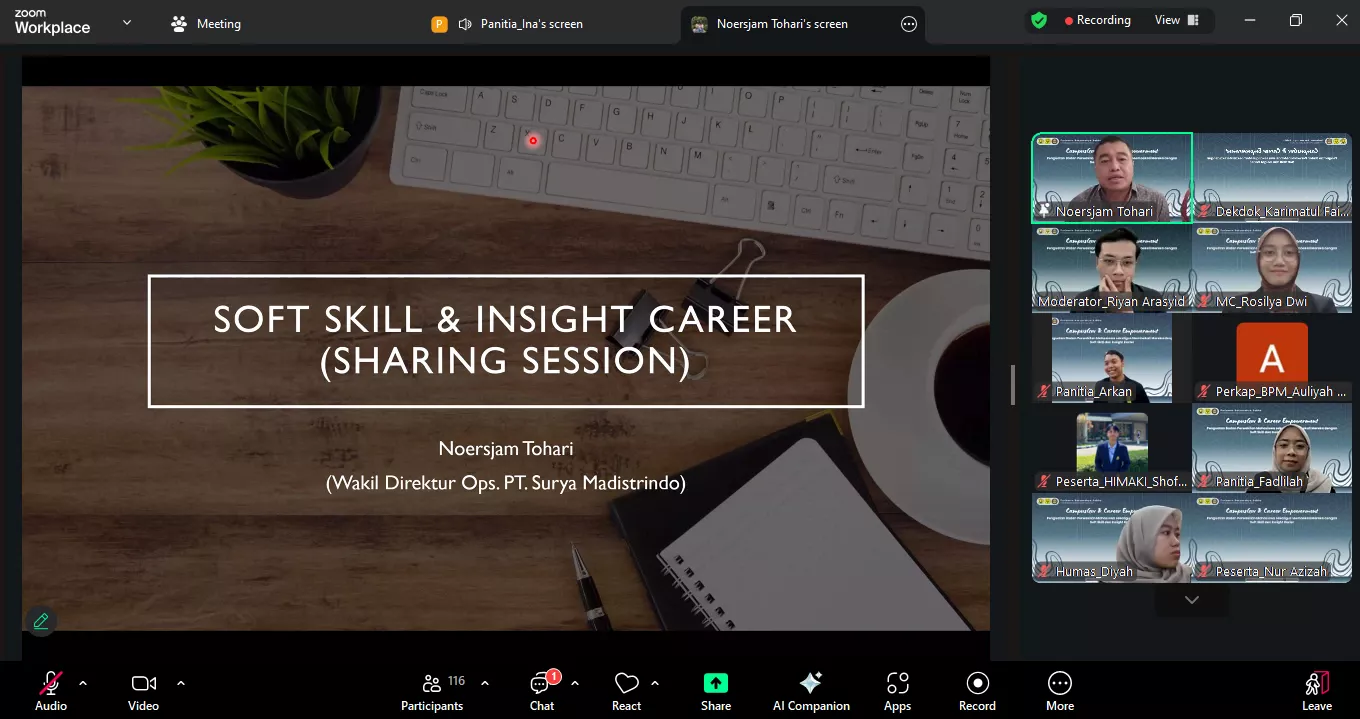
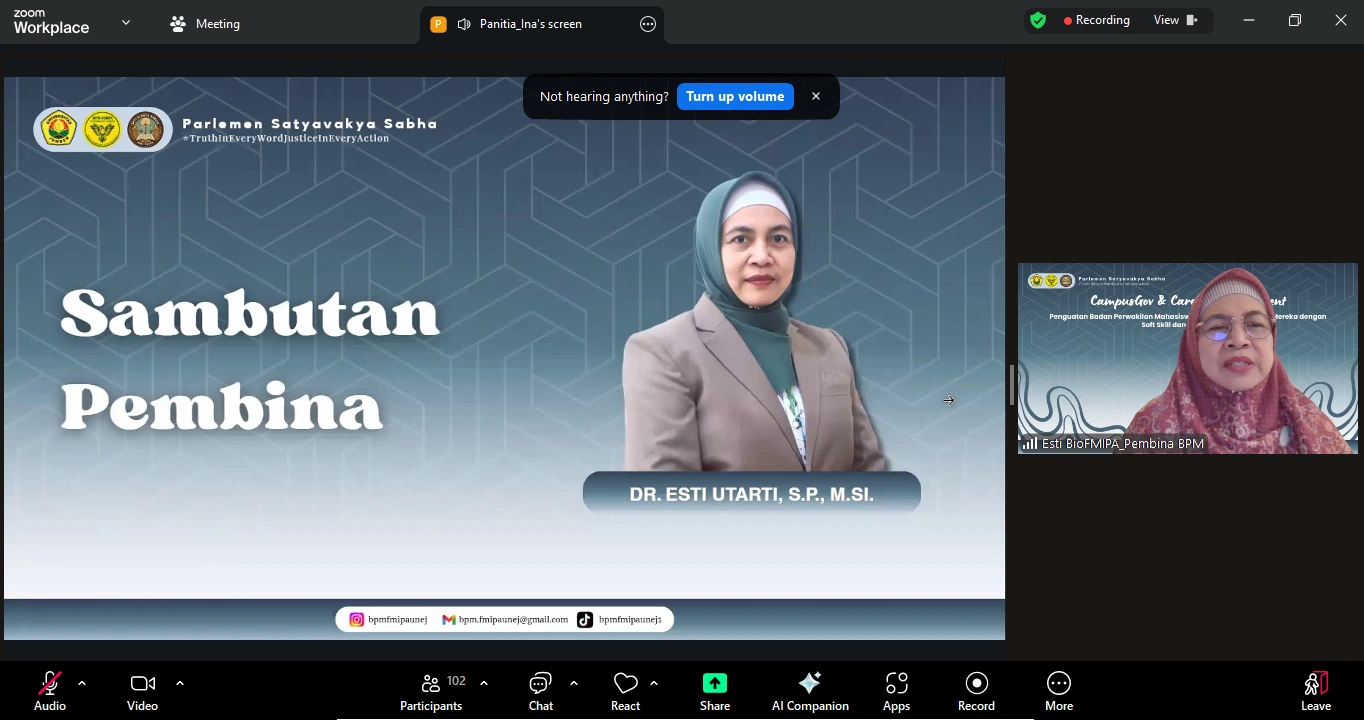
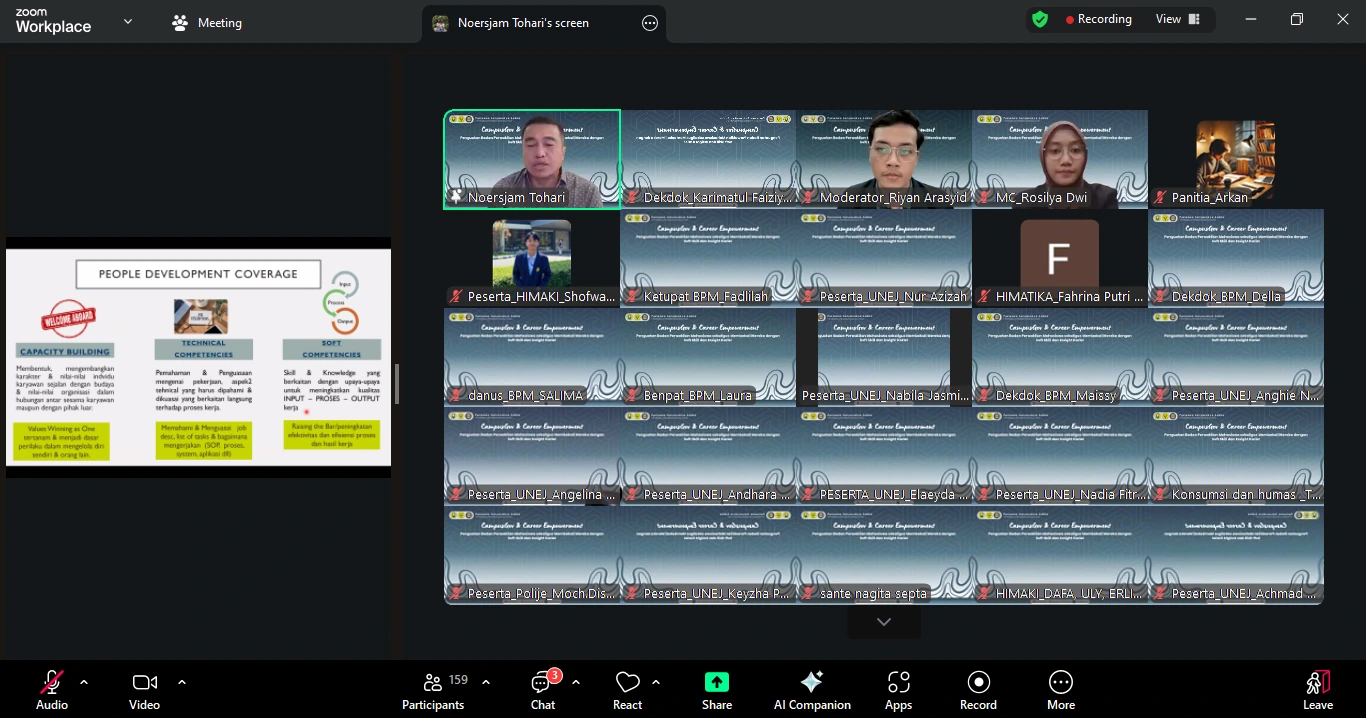
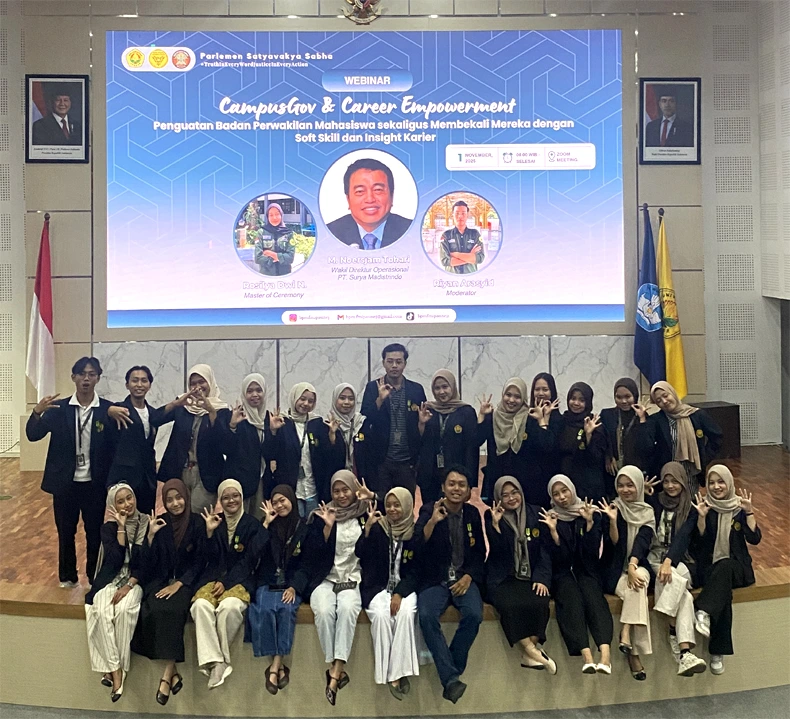
 Badan Perwakilan Mahasiswa (BPM) of the Faculty of Mathematics and Natural Sciences (FMIPA) of the University of East Java (UNEJ) held a CampusGov & Career Empowerment Webinar with Mochamad Noersjam Tohari, Deputy Director of Operations of PT Surya Madistrindo, a subsidiary of PT Gudang Garam Tbk, as a speaker. The theme was “Strengthening the Student Representative Body while Equipping Them with Soft Skills and Career Insights,” and it was opened by Dr. Esti Utarti, S.P., M.Si., Deputy Dean II of FMIPA UNEJ and also the advisor of BPM FMIPA. In her remarks, the Vice Dean II stated that the webinar was held to celebrate the 27th anniversary of FMIPA and the 61st anniversary of UNEJ. Mochamad Noersjam Tohari, familiarly known as Noersjam, shared insights related to soft skill development and preparation for entering the workforce. The webinar was attended by 210 participants from across Indonesia, including those from Universiti Teknologi MARA (UiTM) Malaysia. Participants included not only students but also members of the general public.
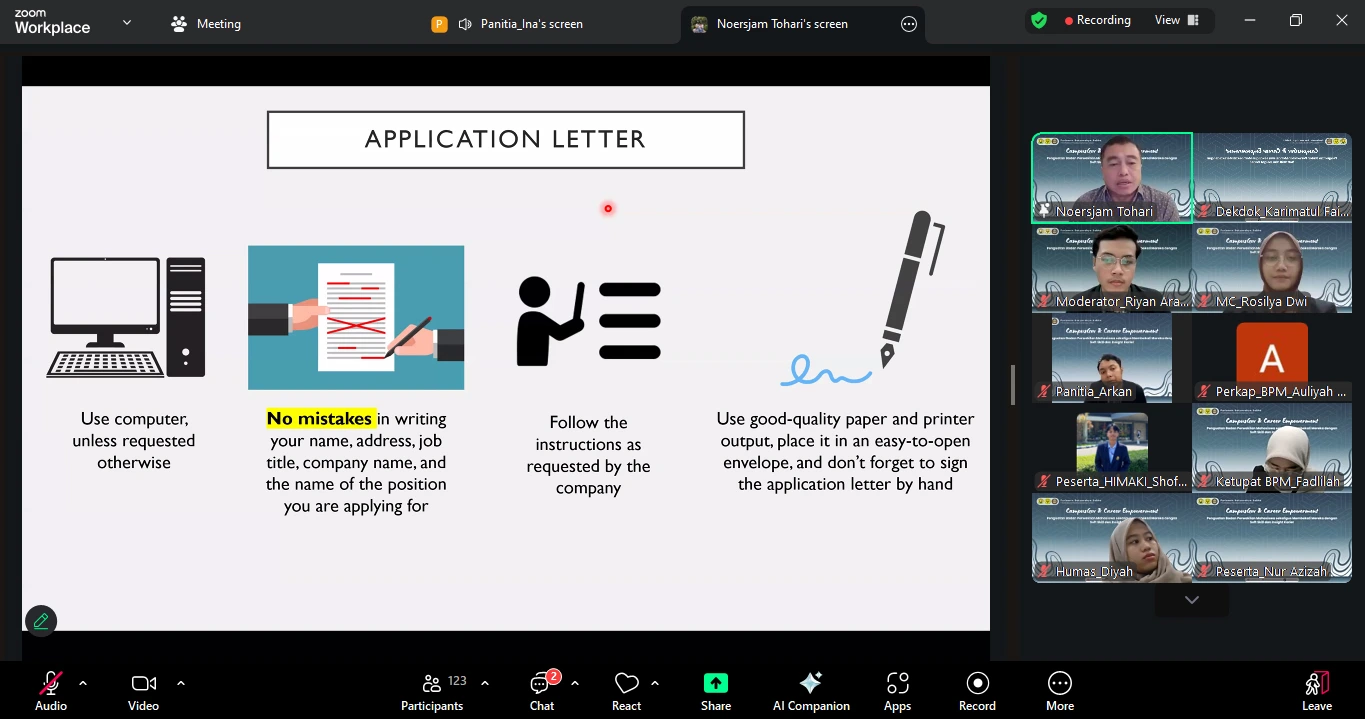
In his presentation, Noersjam emphasized that career readiness is determined not only by academic ability, but also by soft skills and behavioral competencies that demonstrate a candidate’s professionalism. He explained that initial documents, such as the application letter and curriculum vitae (CV), must be neatly structured, concise, and error-free to demonstrate the applicant’s seriousness in participating in the selection process. “The application letter must be concise, to the point, and error-free. The candidate’s seriousness is evident from the initial documents they submit,” he said.
Furthermore, participants were introduced to the competency-based interview method, or CBI, which is increasingly used by large companies. This method utilizes the STAR/CAR (Situation-Task-Action-Result or Context-Action-Result) approach to explore a candidate’s past behavior as a predictor of future performance. Through the STAR/CAR approach, interviewers can assess a candidate’s behavior based on their actual experiences. “Past behavior is the best indicator of how someone will work,” he explained.
In another presentation, Noersjam discussed the Iceberg Competency Model, which illustrates that most of the factors determining a person’s performance, such as attitude, motivation, and character, are not directly visible. These factors are considered to play a greater role than technical knowledge and skills. In fact, according to Harvard University data cited in the session, only about 20 percent of a person’s success is determined by technical competency, while the remaining 80 percent comes from soft skills.
Noersjam also emphasized the importance of self-development when entering the workforce. Students were introduced to levels of thinking processes, from basic skills such as remembering and understanding, to higher-level skills such as analyzing, evaluating, and creating solutions. These levels of ability are closely related to organizational positions. Noersjam hopes students will understand the importance of soft skills and behavioral competencies in building a career.
“We encourage students to continue developing their character, insight, and thinking skills to be ready to face the challenges of an increasingly dynamic workplace,” he concluded. The event was interactive and received a positive response from participants, who felt the activity provided a clear picture of professional demands in the industrial world. And this is a golden opportunity for webinar participants to get information directly from practitioners who have decades of experience in the world of work.
 |
 |
 |
 |