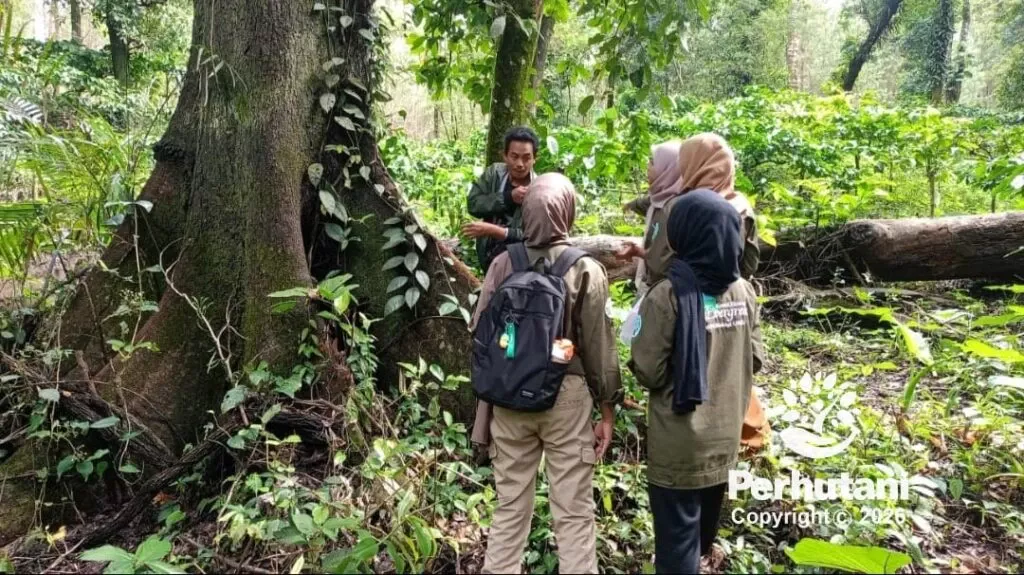
 The Forest Management Unit (KPH) of Jember, along with the Faculty of Mathematics and Natural Sciences (FMIPA) of Jember University, conducted a biodiversity inventory and observation in the Sumberjati RPH of the Sempolan Forest Management Unit (BKPH Sempolan) and the Grintingan RPH of the Wuluhan Forest Management Unit (BKPH Wuluhan) (February 25th). This activity demonstrated the synergy between forest managers and educational institutions in supporting environmental conservation. The Administrator of the Perhutani KPH Jember, Eko Teguh Prasetyo, through the Head of the Environment and Occupational Health and Safety Sub-Section, Ety Sri Wulandari, stated that this collaboration was no ordinary field activity. “This biodiversity activity represents our commitment to opening up collaboration with universities. Forests are not only managed for production, but also for maintaining their ecological function. Students can learn directly, and we obtain important data on the condition of flora and fauna in the field,” said Ety.
According to her, identifying flora and fauna and observing ecosystem conditions are crucial as the basis for sustainable forest management planning. The data obtained can later serve as a reference for policy-making and conservation programs. Meanwhile, the Supervising Lecturer and Vice Dean I of the Faculty of Mathematics and Natural Sciences, Universitas Jember (UNEJ), Prof. Hari Sulistyowati, expressed her appreciation for the full support from Perhutani KPH Jember. “We are very grateful for this opportunity. Students not only learn theory in the classroom, but also gain a first-hand understanding of the dynamics of forest ecosystems. This is a valuable experience for fostering awareness and responsibility for environmental sustainability,” she said. Continue reading