
Tag Archives: biology

12Oct/23

Innovative, FMIPA UNEJ PKM-RE Team Overcomes Shrimp Pond Waste Using Shrimp Shell Biofocculant

“This research is expected to be an alternative to processing waste water from shrimp ponds,” said Rikma Dwi Mukharomah. The research was carried out for 4 months, starting June 16, 2023, at the Physical Chemistry and Organic Chemistry Laboratory, Department of Chemistry, FMIPA, University of Jember. Furthermore, Rikma explained that chitosan-based bioflocculant is synthesized from shrimp shells through several stages, including deproteination, demineralization, and deacetylation. “The result obtained after the deproteination and demineralization processes is chitin, while from the chitin deacetylation process, chitosan is obtained,” she explained.

“This research is expected to be an alternative to processing waste water from shrimp ponds,” said Rikma Dwi Mukharomah. The research was carried out for 4 months, starting June 16, 2023, at the Physical Chemistry and Organic Chemistry Laboratory, Department of Chemistry, FMIPA, University of Jember. Furthermore, Rikma explained that chitosan-based bioflocculant is synthesized from shrimp shells through several stages, including deproteination, demineralization, and deacetylation. “The result obtained after the deproteination and demineralization processes is chitin, while from the chitin deacetylation process, chitosan is obtained,” she explained.

Continue reading

04Oct/23

Parasitic Plants: Sharing Session Lecture on Parasitology by Dr. Zaiton Sapak from Universiti Teknologi MARA Malaysia

Dr. Zaiton Sapak from Universiti Teknologi MARA Malaysia delivered material on parasitic plants in the Parasitology Lecture Sharing session (3/10). Parasitic plants, or parasitic plants, are organisms that settle on host plants through special organs. “This special organ develops and penetrates the host’s vascular tissue and meets the nutritional, water, and mineral needs of the host plant,” began Dr. Zaiton Sapak. It is said that nearly 4,500 species in 28 families, representing 1% of all angiosperm species, utilize the vascular systems of other plants to meet their nutritional needs.

Sharing session guided by Purwatiningsih, S.Si., M.Si., Ph.D. The lecturer at the Department of Biology also explained that parasitic plants are divided into several types, seen as being photosynthetically active (hemiparasites), lacking photosynthetic activity, completely bound to the host for carbon (holoparasites), optional or obligate parasites, and attached to the roots or stems of their hosts. “Parasitic plants” grow in agroecosystems with low biodiversity, and their presence causes huge yield losses on agricultural land,” said Dr. Zaiton Sapak. Continue reading

25Sep/23

Congratulations and Success! FMIPA University of Jember Has Three New Professors  

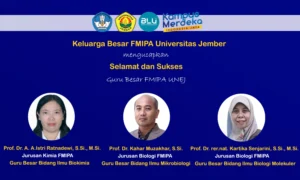
FMIPA Jember University increased the number of professors after the Kementerian Pendidikan, Kebudayaan, Riset, dan Teknologi appointed three lecturers as professors. First Prof. Dr. Anak Agung Istri Ratnadewi, S.Si., M.Si., is a professor in the field of biochemistry in the Chemistry Department, FMIPA. Prof. Dr. Kahar Muzakhar, S.Si., is a professor in the field of microbiology in the Biology Department, FMIPA. And the third is Prof. Dr. rer. nat. Kartika Senjarini, S.Si., M.Si., is a professor in the field of molecular biology, which is also in the Biology Department, FMIPA UNEJ.
“Congratulations and success to the three new professors; it is a matter of pride for us, the FMIPA academic community, for this appointment, so that now there are seven professors at FMIPA UNEJ,” said Drs. Achmad Sjaifullah, M.Sc., Ph.D. Dean of FMIPA, some time ago. The Dean also said that, apart from professors, he also encouraged and provided assistance to all FMIPA lecturers in managing promotions and functional positions. “We pay attention, so we create a special quarantine for lecturers who are committed to fulfilling PAK requirements,” he continued. Continue reading

16Sep/23

Collaboration in Teaching Biodiversity Courses: Masters in Biology, FMIPA UNEJ, and FMIPA UB

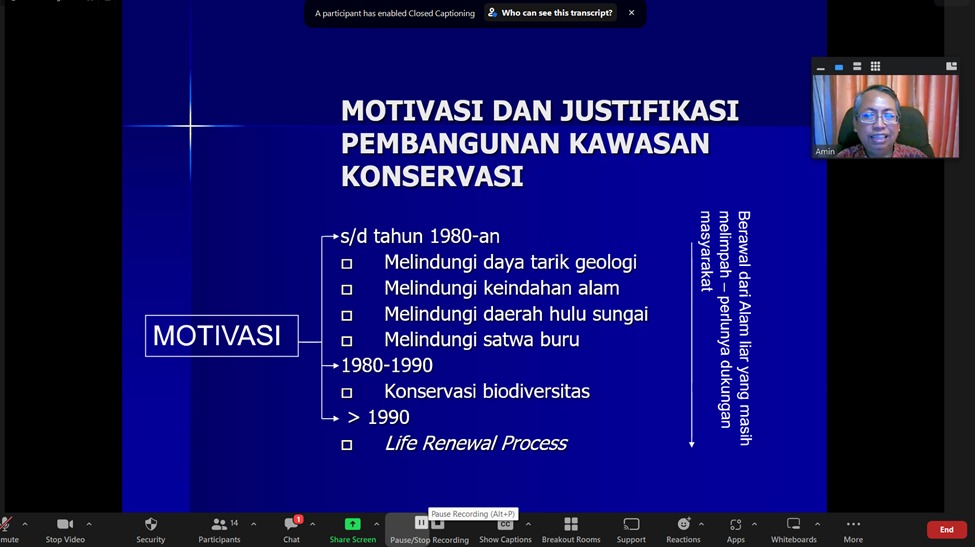
Master of Biology FMIPA Jember University and Master of Biology FMIPA Brawijaya University held a collaboration to teach biodiversity courses online (15/9). Prof. Dr. Amin Setyo Leksono from Brawijaya University, as the speaker, delivered material on animal population estimation methods. “We need an animal population approach first, both census and sampling,” he initially said. Continuing the census requires a lot of personnel to count all the flora in an area. Meanwhile, sampling can be done using direct or indirect analysis.

Prof. Amin continued direct sampling itself, divided into several methods. “There are quadratic methods, transect lines, exploration and exclusion methods, and finally we have to calculate the population size,” he continued. For indirect methods, there are several methods, including traps, concentration calculations, trace counts, and interview methods. The conclusion from the initial session was that the benefit of animal estimation is knowing population dynamics patterns, including influencing factors. “We come to know the potential of each type, its role and benefits, and finally, what policies to take for this population,” he concluded. Continue reading

14Sep/23

FMIPA Biology Holds The 5th ICOLIB 2023 for 2 Days, Presenting Expert Researchers Across Continents

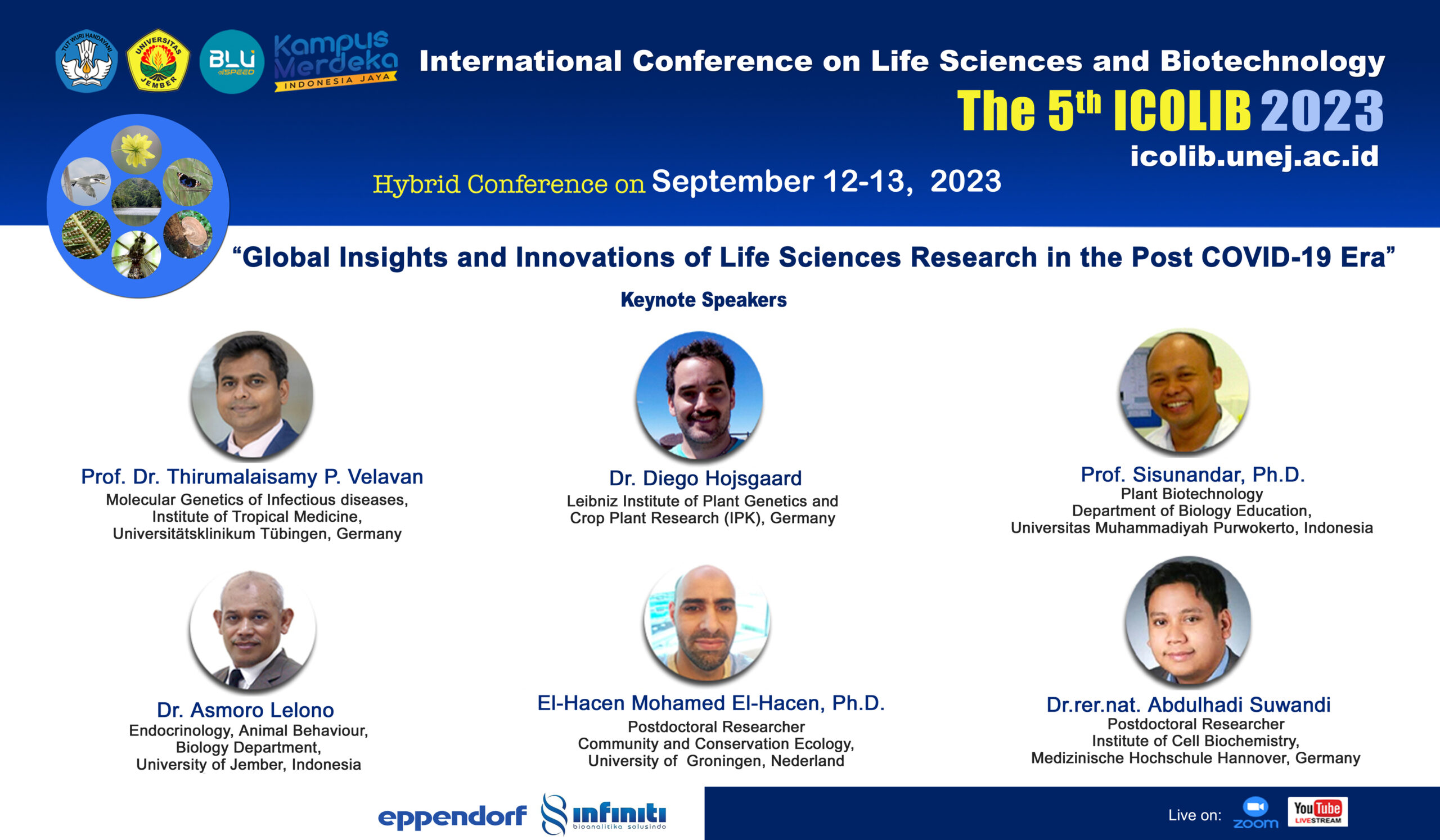
The Department of Biology, FMIPA, University of Jember held the 5th International Conference on Life Sciences and Biotechnology (ICOLIB) 2023 on a hybrid basis (12–13/9). ICOLIB is an international seminar scheduled every two years. The first ICOLIB was held in 2015, and in 2023, this will be the fifth event. Taking the theme “Global Insights and Innovations of Life Sciences Research in the Post-COVID-19 Era,” the topic is applied sciences, basic sciences, biodiversity and bio-conservation, and health and medicine. Keynote speakers were presented from several countries, including Indonesia as the host.

The 5th ICOLIB 2023 was officially opened online by Iwan Taruna, Rector of University of Jember. In his message, Rector invited researchers involved in ICOLIB to exchange information on research results after being hampered by the pandemic for some time. “ICOLIB is a place to share the research results of researchers, and this is very relevant to the vision of the University of Jember, namely to make the university superior in the development of environmentally friendly science, technology, and arts, business, and industrial agriculture,” he said. At the end of the Rector’s speech, he hoped that UNEJ would continue to carry out scientific research through international seminars as one of its means. Continue reading

28Aug/23

Improve Practicum Services, Mathematics Laboratory, and Biology Laboratory FMIPA Holds Short Training

To improve services to students, especially practicums, Mathematics Laboratory and Biology Laboratory of FMIPA UNEJ held short training. The Mathematics Laboratory has theme Peningkatan Kompetensi Asisten Praktikum Kalkulus (25/8). “We equate the perception of delivering practicum material because we serve students in all majors, from introductions, preparation to output from practicum,” said Dr. Agustina Pradjaningsih, S.Si., M.Si. Head of the Mathematics Laboratory. Followed by 23 calculus practicum assistants, the material was delivered by Abduh Riski, S.Si., M.Si. discuss the achievements of each meeting during the practicum implementation.

Separately, the Biology Laboratory plans to develop staff for educational laboratory institutions with the aim of improving practicum services for compulsory subjects in supporting the learning outcomes of graduate students. “The training was held in the sub lab, all PLP are expected to be able to transfer knowledge and expertise so they are able to provide a variety of laboratory services,” said Dra. Hari Sulistiyowati, M.Sc., Ph.D. Head of the Biology Laboratory. The event took place August 7-11 in the microbiology sub-lab, followed by August 14 in the botany sub-lab and August 21-22 in the zoology sub-lab. Continue reading