
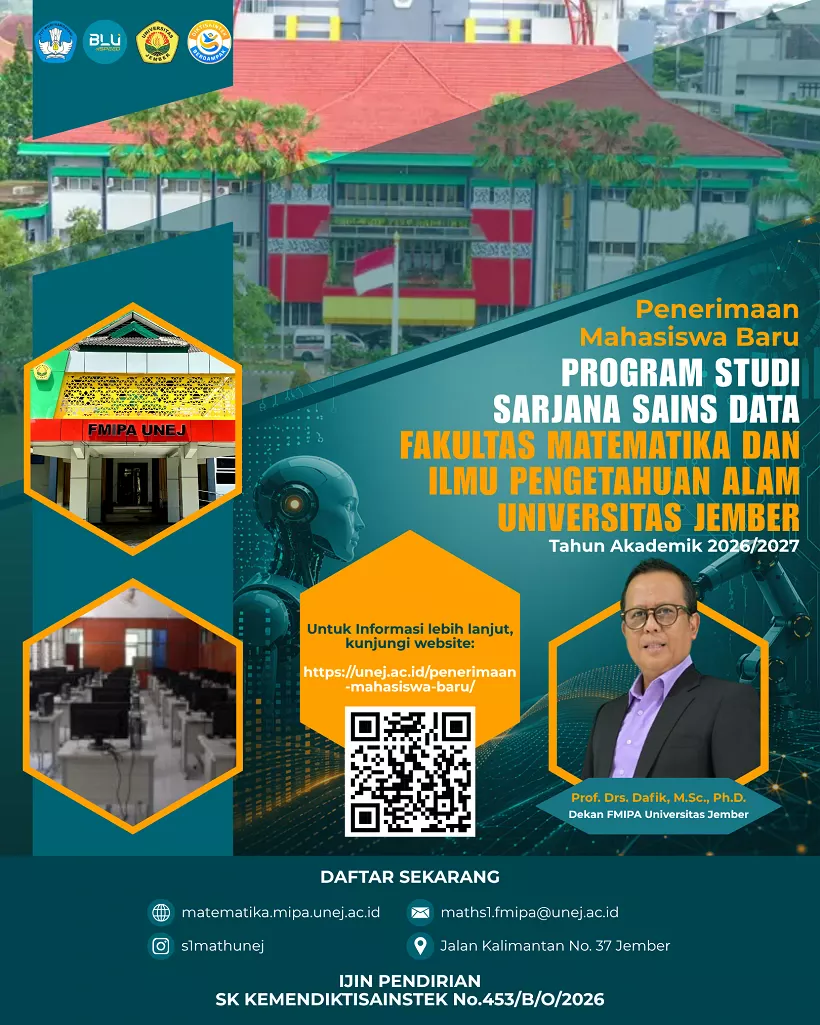
 The Faculty of Mathematics and Natural Sciences (FMIPA) at the University of Jember officially opened the Undergraduate Data Science Program for the 2026/2027 Academic Year. Based on Decree No. 453/B/O/2026 from the Minister of Higher Education, Science, and Technology of the Republic of Indonesia, the introduction of this new study program is a strategic step by FMIPA UNEJ to address the needs of the era of rapid development of digital transformation, artificial intelligence, and data-driven decision-making. Prof. Drs. Dafik, M.Sc., Ph.D., Dean of FMIPA UNEJ, stated that the opening of the Undergraduate Data Science Program is not simply the addition of a new study program, but rather FMIPA UNEJ’s commitment to preparing a superior generation capable of addressing global challenges.
“Today’s world is moving very quickly, with data as the primary foundation for decision-making. Therefore, FMIPA UNEJ presents the Undergraduate Data Science Program to prepare young talents who not only master theory but also are able to process data into real solutions for society and industry,” he said. According to him, the Data Science Undergraduate Program is designed with a core strength in the foundations of mathematics, statistics, and modern computing, which are the hallmarks of the FMIPA. This combination is crucial in producing graduates capable of working adaptively in the digital age.
“We not only teach how to read data, but also how to interpret it. Students will be equipped with analytical skills, machine learning, mathematical modeling, and data-driven decision-making, which are highly needed in various strategic sectors,” he explained. Furthermore, Prof. Dafik explained that this program is unique compared to similar programs elsewhere, namely its integrated orientation with the development of sustainable industrial agriculture. This approach represents a concrete contribution from FMIPA UNEJ in supporting the region’s outstanding potential and national development needs.
“UNEJ is located in a region with significant strengths in the agricultural and agro-industrial sectors. Therefore, we want data science to go beyond theory and address real-world problems, ranging from production efficiency and environmental analysis to strengthening the agro-industrial supply chain,” he said. He added that graduates of the FMIPA UNEJ Data Science Undergraduate Program have vast prospects, as the demand for data talent continues to increase year after year. Not only in the technology sector, but also in government, industry, the environment, and even the digital finance sector.
“Our graduates are projected to pursue careers as Data Scientists, Agroindustry Intelligence Analysts, Environmental Data Analysts, and Blockchain Data Analysts. These are highly sought-after professions of the future and offer significant potential for contribution,” he emphasized. To support the learning process, the FMIPA UNEJ has also prepared various supporting facilities, such as computer laboratories, representative lecture halls, an international space, and student meeting points, all of which support a collaborative and innovative learning ecosystem.
“We want students to learn in a healthy, modern, and collaborative environment. Building data talent isn’t just about a good curriculum; it must also be supported by a strong academic ecosystem,” he added. Through the opening of the Data Science Study Program, FMIPA UNEJ is optimistic about producing a new generation of superior, adaptive, and change-making data scientists. “This isn’t just about opening a new study program. It’s about preparing for the future,” concluded the Dean of FMIPA UNEJ.