
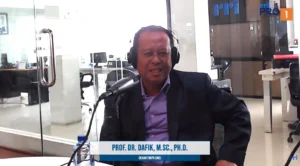
 The development of digital technologies, artificial intelligence, to industrial needs for data processing is now increasing rapidly. Responding to the challenge, the University of Jember officially opened the Bachelor of Studies Program in Data Science under the auspices of the Faculty of MIPA for the intake of new students in 2026. The presence of this new study program marks a strategic step in preparing superior, adaptive, and competitively ready human resources in the era of global digital transformation. In an interactive dialogue with RRI Jember, the Bachelor of Data Science Course was peeled along with UNEJ Vice-Chancellor I, Dean of FMIPA, Head of the Department of Mathematics and teaching Lecturer of the Data Science Bachelor of Studies Programme.
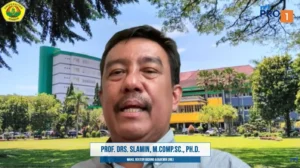
Vice-Chancellor for Academic Affairs University of Jember, Prof. Slamin emphasized that the opening of the Data Science Faculty was not a sudden decision, but rather a result of the real needs of the industrial world and technological developments. “Data science is currently needed in almost all sectors of life.FMIPA becomes the most prepared faculty because it has resources in mathematics, statistics, and computer science,” he explained. According to him, UNEJ also has its own characteristics compared to other colleges, namely focusing on the development of agroindustry-based data analytics as per the vision of the university.
“We want graduates to have an edge in agricultural and agro-industrial data analytics, especially to support the potential of the Horseshoe region,” he added. Meanwhile, the Dean of FMIPA University of Jember, Prof. Dafik explained that human resource readiness became one of the main strengths of the opening of this study programme. FMIPA UNEJ Mathematics Department currently has lecturers with expertise in mathematics, statistics, actuarial, computational, to artificial intelligence who are ready to support the learning of Data Science.
“Data science is present to answer the challenges of big data and technological disruption.The approach requires mathematics, computation, and statistics all of which FMIPA already possesses,” he says. Not only that, the learning process will also involve cross-faculty collaboration, including engineering and agroindustry, so that students are able to solve real problems in society and industry.
Head of FMIPA UNEJ Mathematics Department, Prof. Kiswara Agung Santoso added that the Data Science Department is supported by competent and certified teaching staff. “There are already six BNSP-certified faculty members in data analytics and data science.This becomes one of our advantages,” he explains. In the first year, the Data Science Department opened a quota of 60 students through the independent pathway (SEMABA), which is divided into the achievement pathway and the test pathway.
Interestingly, this program of study is open to all majors, both science, social studies, vocational school, and MA. “All fields now require data. So social sciences students can still enter and will be strengthened mathematical, statistical, and computational skills since the first semester,” explained Prof. Slamin. Lecturer FMIPA UNEJ, M. Ziaul Arif, Ph.D. explains that students will later study machine learning, artificial intelligence, data mining, statistics, to blockchain and digital data analytics.
According to him, Data Science graduates have a very wide range of career opportunities, ranging from data scientists, data analysts, environmental analysts, to intelligent agroindustrial analysts. “Now is the age of data mining.Data can be used to predict the future, read market patterns, even support the digital economy,” he said. He also added that professions in data science are currently in high demand as many support remote working systems with global career opportunities.
 |
 |
 |
 |
This was echoed by Abduh Riski, M.Si. calling for the need for data scientist personnel to continue to increase, both at the national and local levels. “Even small to SMB companies now need data analysts to help with decision-making,” he reveals. At the end of the dialogue, the speakers invited the younger generation, specifically high school/secondary equivalent graduates, to be part of the first batch of the UNEJ Data Science Department.
“If you want to master the future, learn data and become a data scientist,” messages Prof. Kiswara. With the support of competent teaching staff, a curriculum relevant to technological developments, as well as a focus on future industry needs, the Data Science Studies Program of the University of Jember is expected to be capable of producing a young generation that is innovative, excellent, and ready to compete at both national and international levels.
*photo source Youtube RRI Jember